
Buying a concentrate off a menu is easy. Buying a good one is a different skill. If you’ve ever grabbed a jar labeled “live resin” and been let down by a weak smell or a texture that felt off, you already know the label alone doesn’t tell you much. This guide walks through exactly what separates premium crumble live resin from an average jar, what to check before you buy, and what to look for if you’re shopping for live resin crumble for sale online instead of walking into a dispensary.
We’ll keep this practical. No hype, no vague marketing language, just the actual signals worth checking.
What “Premium” Actually Means Here 🌟
“Premium” gets slapped on a lot of concentrate packaging, and most of the time it doesn’t mean anything specific. It’s become a default word, the kind of thing every brand uses regardless of whether it applies, so let’s define it in a way you can actually use.
Premium crumble live resin starts with fresh frozen flower. That means the plant is frozen shortly after harvest instead of being dried and cured first. <cite index=”19-1″>Live resin starts with fresh frozen cannabis instead of dried flower, which preserves more of the terpenes responsible for aroma and nuanced effects.</cite> That single choice, freezing instead of drying, is the foundation everything else on this page builds on.
From there, quality comes down to a handful of concrete things: how the plant was grown, how carefully it was frozen and extracted, how it was purged, and how it’s been stored since. None of those are things a label can fake for long. They show up in the color, the smell, and the lab results, which is exactly what we’re about to walk through, one signal at a time.
It also helps to know what “premium” doesn’t automatically mean. It doesn’t mean the highest THC number on the shelf. It doesn’t mean the most expensive jar in the case. And it doesn’t mean whatever strain happens to be trending that month. Those things can line up with quality, but none of them guarantee it on their own. The rest of this guide is built around the checks that actually do.
Start With the Source Material 🌱
Good live resin is only possible if the starting flower was good to begin with. <cite index=”19-1″>Fresh frozen input matters more than THC percentage, and a well-grown, well-frozen crop will outperform a higher-THC but poorly handled one.</cite> That’s worth sitting with for a second, because a lot of shoppers do the opposite: they sort by THC percentage first and everything else second.
A trichome-rich strain with a strong, distinct terpene profile is the better starting point. <cite index=”15-1″>The best results come from starting with a trichome-rich strain that has a strong terpene profile, then freezing the fresh buds immediately after harvest.</cite> If the flower going in is weak or the freezing happens too late, no amount of careful extraction afterward can fully make up for it.
This is also why strain choice matters as much as brand choice. A strain that’s naturally terpene-heavy has more room to shine once it’s turned into a concentrate. A low-terpene strain, even handled perfectly, has less to work with from the start.
There’s also a growing season component that’s easy to overlook. Cannabis is an agricultural crop, and weather, harvest timing, and even small differences in how a specific plant developed can all shift the final terpene balance slightly. That’s true even within the same strain grown by the same operation. It’s one reason premium producers lean on batch-specific testing instead of a single generic spec sheet for a strain name. The plant in front of you, not the strain name on the label, is what actually determines what you’re getting.
Judge It With Your Eyes First 👀
Before you even open the container, look at it. Color and texture tell you a lot.
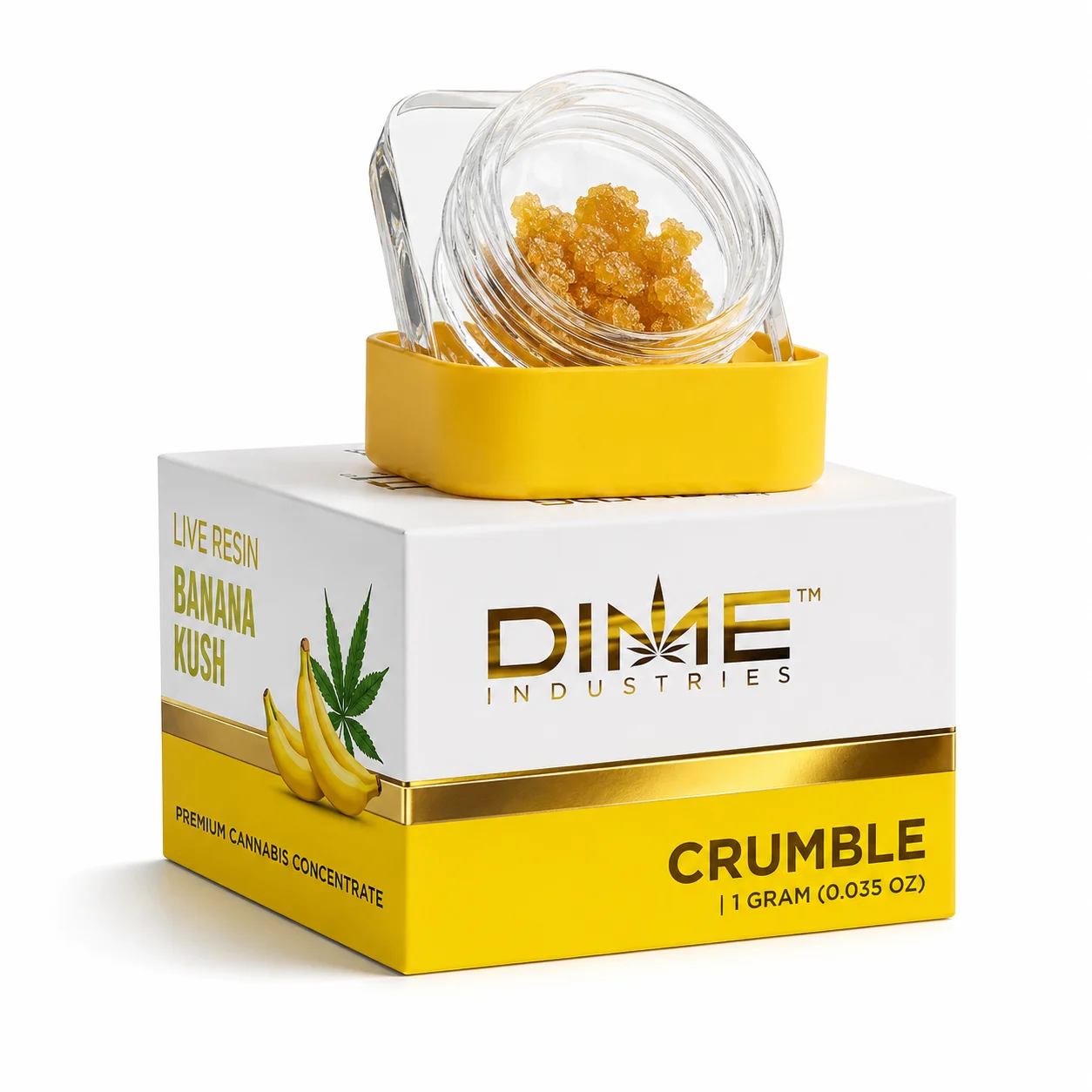
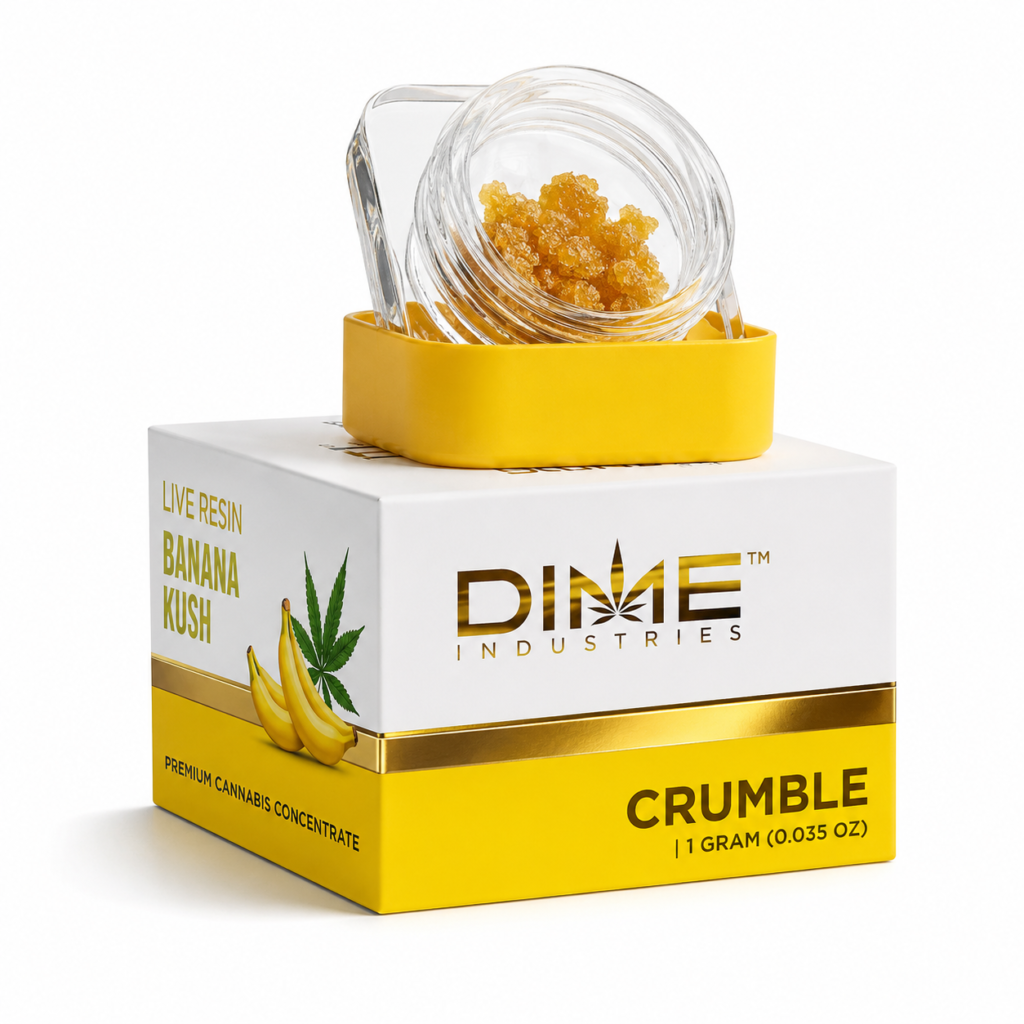
Premium crumble should be a golden to light amber color. <cite index=”14-1″>High-quality live resin should have a vibrant color ranging from light yellow to amber, and you should avoid products that look dull, overly dark, or dry.</cite> A batch that looks flat brown or lifeless usually points to rougher processing, older material, or both.
Texture matters too, though crumble has its own standard compared to other concentrate types. It should break apart cleanly into small, dry pieces. It shouldn’t look wet, oily, or overly sticky, and it shouldn’t be a hard, glassy sheet either (that’s shatter, a different texture entirely). A little visible shine is a good sign. That shine usually comes from terpene content sitting on the surface, and a batch with almost none of it has often already lost some of its aroma.
Look closely at consistency across the batch too, not just the top layer. Sometimes a jar looks fine at first glance but has softer, wetter material underneath, which can point to uneven purging or storage issues after the fact. If you’re shopping in person, most dispensary staff will let you take a closer look before you buy, and it’s worth asking rather than assuming everything under the surface matches what’s visible on top.
Then Trust Your Nose 👃
If the visual check passes, smell is next, and it’s arguably the most reliable test you can do on the spot.
Premium live resin should smell strong, fresh, and specific to the strain. <cite index=”18-1″>High-quality live resin should smell strong and fresh, like a jar of fresh cannabis flowers just opened, while strange or chemical smells are red flags pointing to bad processing or impurities.</cite> If you can pick apart individual notes (fruit, pine, gas, whatever the strain calls for) instead of one flat, generic smell, that’s a strong signal the terpene content survived the process.
A faint smell is a warning sign on its own. <cite index=”18-1″>A faint or chemical-like smell can be a sign that the resin is old, contaminated, or poorly extracted, and it may sometimes point to solvents that weren’t fully purged out.</cite> That last part matters for safety, not just enjoyment. Leftover solvent isn’t something you want in a product you’re using, which is exactly why the next section (lab testing) isn’t optional if you’re being careful.
If you’re shopping online and can’t smell the product ahead of time, this is one more reason the earlier checks (color, described texture, and available documentation) carry extra weight. A detailed, honest product description that mentions specific aroma notes, rather than a single vague word like “fruity” or “gassy,” is at least a small signal that whoever wrote it actually experienced the batch rather than copying generic strain notes from somewhere else.
Read the Lab Results Before You Buy 🧪
This is the step people skip most often, and it’s the one that actually protects you.
Every legitimate batch of live resin should come with a Certificate of Analysis, usually shortened to COA. <cite index=”22-1″>Online THC product safety should be verified by checking for a batch-specific Certificate of Analysis from an ISO 17025 accredited third-party laboratory.</cite> That accreditation detail matters. A lab report from an uncertified lab doesn’t carry the same weight.
A useful COA covers more than just potency. <cite index=”22-1″>The COA should confirm cannabinoid potency and show passed tests for pesticides, heavy metals, residual solvents, and microbial contaminants.</cite> If a product doesn’t have accessible, current lab documentation, that’s reason enough to walk away and look elsewhere, no matter how good the marketing photos look.
Here’s a simple checklist for reading a COA on any crumble live resin product:
- 🧬 Cannabinoid panel (confirms THC and CBD levels match what’s on the label)
- 🌿 Terpene panel (shows which terpenes are present and roughly how much of each)
- ⚠️ Residual solvent screen (confirms extraction solvents were properly purged)
- 🦠 Contaminant screen (checks for pesticides, heavy metals, and microbial growth)
- 🔢 Matching batch number (the number on the COA should match the number on your container)
If a brand makes this easy to find (a QR code on the jar, a link on the product page), that’s a good sign about how seriously they take transparency in general. <cite index=”22-1″>Reputable brands make COAs easily accessible through QR codes on packaging or their website, which demonstrates transparency about product quality and compliance.</cite> If you have to dig for it or it’s nowhere to be found, take that as a signal too.
One more thing worth checking: the date on the COA. Lab testing reflects the batch at the time it was tested, and cannabinoid and terpene content both shift over time, especially terpenes, which fade faster than cannabinoids do. A COA from over a year ago attached to a product you’re buying today isn’t necessarily wrong, but it’s telling you less about the jar currently in front of you than a recent test would.
It’s also worth understanding who’s supposed to be doing this testing in the first place. Independent third-party labs exist specifically because a producer testing its own product has an obvious incentive problem. That’s why accreditation matters so much here. A lab with proper accreditation follows standardized methods that can be checked and repeated, rather than running tests in a way that’s convenient for whoever’s paying the bill.
Understand What Makes Crumble Different 🧱
“Live resin” describes the process. “Crumble” describes the texture. It’s worth understanding both, since they’re doing different jobs on the label.
Crumble is a dry, brittle texture that breaks apart into small pieces instead of stretching or staying sticky. It sits between two other common textures: shatter, which is thin and glass-like, and badder (or budder), which is soft and whipped like frosting. Crumble lands in the middle, drier and easier to handle than badder but not as brittle and fragile as shatter.
None of these textures is inherently better than another. They’re the result of different choices made during the final whipping and cooling stage of processing. What matters for you as a buyer is knowing what you’re actually getting so you’re not surprised when you open the jar. If you prefer something that doesn’t stick to your fingers and breaks apart cleanly, crumble is usually the easiest texture to handle day to day.
Texture also affects how consistent a product feels use after use. Sauce and badder can shift in consistency depending on temperature, sometimes noticeably, from one session to the next. Shatter can be brittle enough to crack unpredictably when you try to portion it. Crumble tends to stay more stable across a wider temperature range, which is part of why a lot of people who buy concentrates regularly gravitate toward it as an everyday option rather than reserving it for anything special.
Terpene Content Is the Real Quality Signal 🧬
A lot of shoppers default to comparing THC percentages side by side. That’s not wrong, exactly, but it’s an incomplete way to judge quality, especially for something like live resin, where the entire point of the fresh frozen process is preserving terpenes, not just cannabinoids.
<cite index=”19-1″>Live resin is extracted using solvents, but the goal is to keep as much of the plant’s original terpene profile intact as possible, since terpenes are the compounds responsible for aroma and nuanced effects.</cite> A high THC number on a product that smells flat and generic usually means a lot of that original terpene content didn’t make it into the jar.
When you’re comparing two products, put the terpene percentage on the COA next to the THC percentage, not just the THC number by itself. A product with a strong terpene profile alongside solid cannabinoid content is a better overall pick than one that’s high in THC but thin on terpenes. That combination (both numbers being solid) is closer to what “full-spectrum” is actually supposed to mean.
Small Batch Production Is a Real Advantage, Not Just a Buzzword 🏺
“Small batch” shows up on a lot of packaging, and it’s fair to be skeptical of the phrase by itself. But there’s a real, practical reason it matters for live resin specifically.
Fresh frozen extraction depends on tight timing. Flower needs to be frozen within hours of harvest, and processed while that timing advantage still holds. Large scale operations moving huge volumes at once have a harder time keeping that kind of precise timing consistent across every batch. Smaller, more closely managed runs make it easier to track a batch from plant to package and catch problems before they reach a shelf.
This doesn’t mean every small batch product is automatically better, and it doesn’t mean every large producer cuts corners. But when you see “small batch” paired with real batch identification numbers and available lab results, that combination is a genuinely useful signal, not just marketing language sitting on its own.
Watch for These Red Flags 🚩
A handful of warning signs apply across almost any live resin crumble purchase, whether you’re at a dispensary counter or shopping live resin crumble for sale online.
No lab results available. This is the biggest one. <cite index=”22-1″>Avoid any product without accessible, current lab testing documentation.</cite> No exceptions here.
A weak or chemical smell. As covered above, this often points to old material, poor extraction, or leftover solvent.
Dull, dark, or overly wet appearance. Quality crumble should look golden, dry, and have a bit of shine.
Vague or missing batch numbers. If you can’t match the product in your hand to a specific lab report, you’re buying on trust alone.
Prices that seem too low for the format. Live resin is more labor intensive to produce than standard concentrates, and pricing that’s dramatically below market rate for the category is often a sign that something was cut, whether that’s the extraction quality, the testing, or the source material itself.
No information about the extraction method. A brand that can’t or won’t tell you how the product was made isn’t giving you enough to make an informed choice.
Inconsistent labeling between the jar and any online listing. If the strain name, batch number, or potency figures on the physical packaging don’t match what was advertised when you ordered, that mismatch is worth questioning before you use the product, not after.
Marketing language standing in for actual detail. Words like “exotic,” “top-shelf,” or “premium” used repeatedly without any specifics behind them (no batch number, no terpene breakdown, no explanation of process) are filler. They cost nothing to print on a label and don’t tell you anything you can verify.
Buying Live Resin Crumble for Sale Online 💻
Shopping online adds a few extra things to check compared to standing at a dispensary counter with the jar in your hand. You can’t smell it or look at the texture before you buy, so the documentation matters even more.
First, confirm the seller is actually licensed to sell where you live. Legal cannabis and hemp-derived product rules vary a lot by state, and what’s compliant in one place isn’t automatically compliant in another. <cite index=”27-1″>Federal law opens the door for hemp-derived products to be sold and shipped across state lines, but individual states still decide how wide that door actually stays, including restrictions on product types and total THC content.</cite> Don’t assume a listing that ships nationwide is automatically legal for your specific state.
Second, check purchase limits if you’re buying from a state-licensed marijuana retailer rather than a hemp-compliant brand. These limits vary by state and are usually set per day or per transaction. <cite index=”24-1″>Concentrate purchase limits commonly run around several grams per day depending on the state, with specific caps set by each state’s regulations.</cite> A legitimate licensed retailer will enforce these automatically at checkout rather than letting you buy an unlimited amount.
Third, look for the same documentation you’d want in person, just made available digitally instead. That means product pages with real COAs linked or attached, batch numbers you can look up, and clear information about the extraction method. If a site has none of that and just shows a product photo and a price, treat it the same way you’d treat an unlabeled jar at a physical counter.
It’s also worth knowing that the legal landscape around hemp-derived concentrates specifically has been shifting. <cite index=”26-1″>Under federal law between April and November 2026, hemp remains legal with less than 0.3% Delta-9 THC by dry weight, but high-potency hemp concentrates including live resin and live badder are expected to fall outside that standard once new restrictions take effect in November 2026.</cite> If you’re buying a hemp-derived live resin product online rather than one from a state-licensed marijuana dispensary, it’s worth checking current rules before you order, since this is an area that’s actively changing.
A few practical habits make online buying safer overall. Order from sellers who list a physical business address and license number, not just a storefront with no verifiable identity behind it. Check whether the site discloses its testing lab by name, since a specific, named lab is easier to verify than a vague reference to “third-party testing.” And if a deal looks unusually good compared to everything else on the market, treat that as a prompt to check the documentation more closely rather than less.
Shipping matters too. Licensed marijuana retailers generally can’t ship across state lines, since state-licensed cannabis remains illegal to transport interstate under federal law regardless of state legalization status. If a site claims to ship marijuana-derived live resin nationwide, that claim itself is worth questioning. Hemp-derived products operate under a different, federally connected framework, which is part of why the distinction between the two categories matters so much for anyone buying online.
Storage After You Buy 🗄️
Even a genuinely premium batch won’t stay that way forever if it’s stored badly. A few habits protect the investment you just made.
- 🌡️ Keep it somewhere cool. Heat is the fastest way to lose terpene content and soften crumble’s texture.
- 🌑 Keep it out of direct light. Light exposure degrades both cannabinoids and terpenes over time.
- 🔒 Reseal the container tightly every time. Air exposure lets terpenes escape gradually.
- 📦 Store it upright so the concentrate doesn’t shift or smear inside the container.
None of this requires special equipment. A cool, dark drawer or cabinet away from any heat source does most of the work.
Price vs. Quality: What You’re Actually Paying For 💰
Premium live resin costs more than standard concentrates, and that gap isn’t arbitrary. <cite index=”14-1″>Live resin typically costs more than standard concentrates and flower, though because it’s more potent and flavor-forward, many consumers find that smaller amounts are needed per session, which helps offset the price difference.</cite> Fresh frozen material, tighter extraction timing, and small batch processing all add real labor and cost compared to a standard cured concentrate.
That said, a high price doesn’t guarantee quality on its own any more than a low price guarantees a bad product. Use price as one data point alongside everything else on this page (appearance, aroma, lab results, and batch transparency), not as a stand-in for all of them combined.
It helps to think about price per session rather than price per gram alone. A stronger, terpene-rich concentrate that lets you use a smaller amount to get the experience you’re after can end up costing about the same as a cheaper, weaker product used in larger quantities. That math doesn’t hold in every case, but it’s a more useful comparison than looking at the sticker price by itself.
A Quick Comparison: Crumble vs. Other Live Resin Textures 📊
If you’re new to shopping for live resin specifically, here’s how crumble stacks up against a few other common textures you’ll see labeled the same way.
Crumble: Dry, brittle, breaks apart into small pieces. Easy to handle, doesn’t stick to fingers or tools.
Badder/Budder: Soft and whipped, closer to cake frosting. Easier to scoop but stickier to handle.
Sauce: Looser, often with visible crystals sitting in a terpene-rich liquid. Very strong aroma, but messier to handle.
Shatter: Thin, glass-like, and brittle. Snaps rather than crumbles, and can be trickier to portion out cleanly.
Live rosin: Not a texture on its own, but a different extraction method entirely. <cite index=”19-1″>Rosin is made using water, heat, and pressure with no chemical solvents, which is often considered the cleanest extraction method, though the final quality still depends heavily on the starting flower.</cite> Live rosin can come in several of the textures above.
None of these is a universal “best” choice. It comes down to how you like to handle your concentrate and which aroma profile matters most to you.
Frequently Asked Questions ❓
What makes crumble live resin “premium” compared to a standard concentrate? Fresh frozen source material, careful low-temperature extraction, small batch processing, and available lab testing. All four together are what separate a premium product from an average one.
Is a higher THC percentage always a sign of better quality? No. Terpene content matters just as much, if not more, for live resin specifically, since preserving terpenes is the entire reason the fresh frozen method exists in the first place.
How can I check quality before opening the container? Look at the color (golden to light amber is ideal) and check whether the packaging includes a batch number linked to a current lab report.
What should I do if a product has no COA available? Skip it. A lack of accessible lab testing documentation is one of the clearest warning signs you can find.
Is it safe to buy live resin crumble for sale online? It can be, as long as the seller is properly licensed for your state, purchase limits (where applicable) are respected, and batch-specific lab results are available for the specific product you’re ordering.
How much should I expect to pay for premium crumble live resin? Pricing varies by region and by strain, but live resin generally costs more per gram than standard dried-flower concentrates because of the extra handling fresh frozen extraction requires. Comparing price per session rather than price per gram gives you a more useful picture than the sticker price alone.
Does crumble stay fresh as long as other concentrate textures? With proper storage (cool, dark, sealed), crumble holds up well, though like any concentrate it will gradually lose some terpene content over time regardless of texture.
Why do some batches of the same product look or smell slightly different? Small batch production means natural variation from one harvest to the next is normal. Weather, harvest timing, and small differences in the extraction process can all shift color, aroma, or texture slightly.
What’s the difference between live resin and live rosin? Live resin uses a chemical solvent (commonly butane or propane) on fresh frozen flower. Live rosin uses heat and pressure instead of a solvent, applied to similar fresh frozen material.
The Bottom Line 🧾
Choosing premium crumble live resin comes down to a short list of checks you can actually run every time: look at the color, trust your nose, read the lab results, and confirm the batch number matches what’s on the COA. None of that requires special expertise, just a habit of checking before you buy instead of trusting the label at face value.
If you’re shopping live resin crumble for sale online instead of in person, lean even harder on documentation, since you don’t get the chance to smell or handle the product first. A seller with nothing to show you beyond a product photo and a price tag isn’t giving you enough information to make a good decision, no matter how the marketing reads.
Do this consistently, and you’ll spend less time guessing and more time actually enjoying a product that lives up to what the label claims.
Quick Reference: Before You Buy ✅
If you only remember one part of this guide, use this as your checklist next time you’re standing at a counter or scrolling a product page.
- 👀 Color check. Golden to light amber, with visible shine. Skip anything dull or dark brown.
- 👃 Smell check. Strong, fresh, and specific to the strain. Skip anything faint or chemical-smelling.
- 🧪 Lab results. Confirm a current COA exists from an accredited lab, and that the batch number matches your container.
- 🌿 Terpene percentage. Look at it alongside THC, not instead of it.
- 🏺 Batch transparency. Small batch claims mean more when paired with a real, traceable batch number.
- 🗄️ Storage plan. Cool, dark, sealed, upright. Have a spot ready before you get home.
- 💻 Licensing (for online orders). Confirm the seller is licensed for your state and that shipping is actually compliant with where you live.
Run through that list a few times and it stops being a checklist you have to think about. It just becomes how you shop.
