Crumble Live Resin Northern Lights, In Short
Crumble Live Resin Northern Lights is a premium live resin concentrate made from Northern Lights cannabis plants frozen right after harvest, instead of dried and cured first. 🌲 That fresh frozen step is what locks in the earthy pine aroma, herbal notes, and smooth finish that have made Northern Lights one of the most recognized cultivars in the world for decades. The texture is a dry, golden crumble, easy to break apart and easy to handle, and this page covers everything from flavor and terpenes to storage and lab testing so you know exactly what you’re buying.
Why This Northern Lights Live Resin Stands Out
Frozen Within Hours of Harvest
Skipping the normal dry and cure means the plant’s volatile terpenes never get the chance to break down or evaporate. That’s the whole reason live resin tends to smell and taste closer to the actual living plant.
Extraction Built Around Flavor
Careful temperature control during extraction and purging helps hold onto more of Northern Lights’ natural myrcene, pinene, and caryophyllene content instead of cooking it off.
Easy to Handle, Easy to Store
Crumble is drier and less sticky than sauce or badder, which makes it simpler to portion out and less likely to make a mess in your storage container.

Quality Control at Every Step
Small batches mean tighter control over temperature, timing, and purge quality, which is a big part of what separates a clean, consistent crumble from an average one.
Is Crumble Live Resin Northern Lights Right for You?
This isn’t a strain built around bright, candy-like flavors, so it helps to know what you’re actually signing up for. Northern Lights leans earthy and piney, which tends to appeal most to people who already have some concentrate experience and specifically want that classic, old-school cannabis smell instead of something sweeter or fruit-forward. If you grew up around cannabis culture in the 90s or 2000s, or you’ve heard longtime smokers talk about what “real weed” used to smell like, this is close to that reference point.
It also tends to appeal to people who care about strain history and genetics. Northern Lights isn’t a strain chasing a trend, it’s one of the strains that helped create the trends other cultivars are still chasing today. If you like knowing the story behind what you’re buying, not just the flavor notes, this product was built with that kind of buyer in mind. And if you’ve been comparing indica-leaning live resin options and want something recognizable and consistent rather than a newer, less-documented cross, Northern Lights is about as established as this category gets.
On the flip side, if you’re mainly looking for something bright, fruity, or dessert-leaning, this probably isn’t the best starting point. There’s nothing wrong with that preference, it’s just a different lane, and the comparison table further down this page can help point you toward a flavor that might fit better.
What Makes Live Resin Different From Other Concentrates?
A quick rundown so you know exactly what you’re comparing this to.
Live resin vs. cured resin. Cured resin starts from flower that’s already been dried and cured before extraction, which is standard practice for most concentrates. That process works fine for flower meant to be smoked, but it costs terpenes along the way. Live resin skips that step by freezing the plant fresh, so more of Northern Lights’ original earthy, piney character survives into the final product.
Live resin vs. distillate. Distillate goes through heavy refining that strips out nearly everything except cannabinoids, terpenes included. Most distillate gets terpenes added back afterward, sometimes from the source strain, sometimes from an unrelated source. Live resin never needs that step because nothing was stripped out in the first place.
Live resin vs. wax. Wax is usually made from cured material and whipped into a soft, opaque texture during purging. It can still carry decent flavor, but starting from dried flower instead of fresh frozen plant generally means a more muted terpene profile than live resin delivers.
Live resin vs. shatter. Shatter gets purged into a hard, glass-like slab. That stability comes from the purge method, not from using fresh frozen material specifically, so shatter can technically be made from either cured or fresh frozen plant. Texture alone won’t tell you which one you’re holding.
Live resin vs. rosin. Rosin skips chemical extraction entirely, using only heat and pressure. It’s a different tradeoff: rosin avoids solvents completely, while live resin uses a hydrocarbon solvent but starts from fresher, less-processed plant material. Neither one is automatically better, it comes down to whether solvent-free processing or maximum terpene range matters more to you.
Northern Lights Flavor, Broken Down
| Attribute | Description |
|---|---|
| Primary Flavor | Earthy |
| Secondary Flavor | Pine |
| Finish | Herbal |
| Sweetness | Mild |
| Citrus | Low |
| Spice | Medium |
| Woody Notes | Strong |
Primary flavor, earthy. This is the backbone of the whole profile. Northern Lights leans on myrcene as its main terpene, and myrcene is what gives it that deep, musky, soil-like base note. It’s the flavor longtime smokers describe as classic, old-school weed.
Secondary flavor, pine. Pinene cuts through the earthiness with a sharper, forest-like note. Some phenotypes lean more toward this alpha-pinene character, which smells close to a pine forest after rain.
Finish, herbal. As the exhale settles, a green, herbal quality comes through, more fresh-cut plant than sweet or fruity.
Sweetness, mild. There’s a light sweetness in the background, but it never takes over. This isn’t a dessert-style strain.
Citrus, low. Some batches carry a trace of citrus from limonene, but it’s usually a minor supporting note rather than a headline flavor.
Spice, medium. Caryophyllene adds a peppery warmth that shows up more on the exhale than the initial hit.
Woody notes, strong. Between the pine and the earthy base, this concentrate reads as woody from start to finish, which is part of what makes it feel so recognizably old-school.
Temperature makes a real difference in how much of that range you actually taste. Dab it too hot and you’ll mostly get a flat, burnt earthiness with the pine and herbal complexity cooked off. Keep it low and slow and the layered structure, pine up front, earth in the middle, spice on the finish, comes through a lot more clearly.
Northern Lights Aroma, Layer by Layer
The primary aroma hits with earth, forest pine, and fresh herbs, all at once. It’s not a sharp or sour smell, it’s grounded and heavy, which fits a strain that’s been described as near-pure indica for decades. Give it a second and a secondary aroma comes through underneath, sweet wood, a light spice, and sometimes a subtle floral note depending on the batch and how it was cured before extraction.
That layered structure is what separates a well-made batch from a flat, one-note jar. If everything you smell reads as identical from the second you open the lid to an hour later, that can be a sign the terpene profile didn’t survive the extraction process particularly well. A properly handled Northern Lights live resin should keep shifting subtly the longer the jar’s been open.
The finish is where Northern Lights really earns its reputation. A clean woodland aroma lingers well after the jar’s been opened, backed by a long-lasting herbal scent that doesn’t fade as fast as brighter, more citrus-forward strains tend to. If you’ve ever walked into a cabin that smells like pine and old wood, that’s roughly the emotional register this aroma sits in.
What to Look For
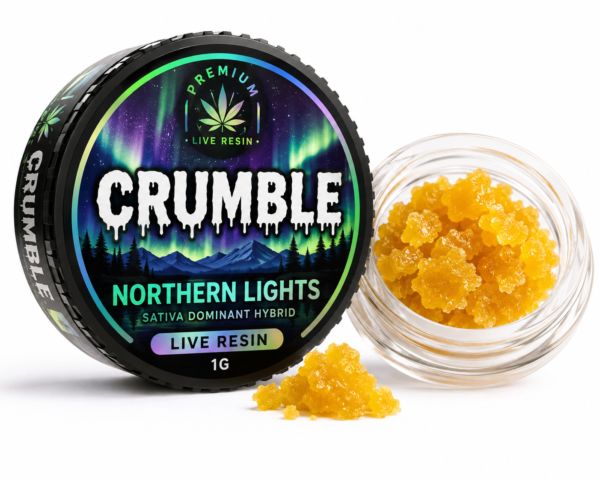
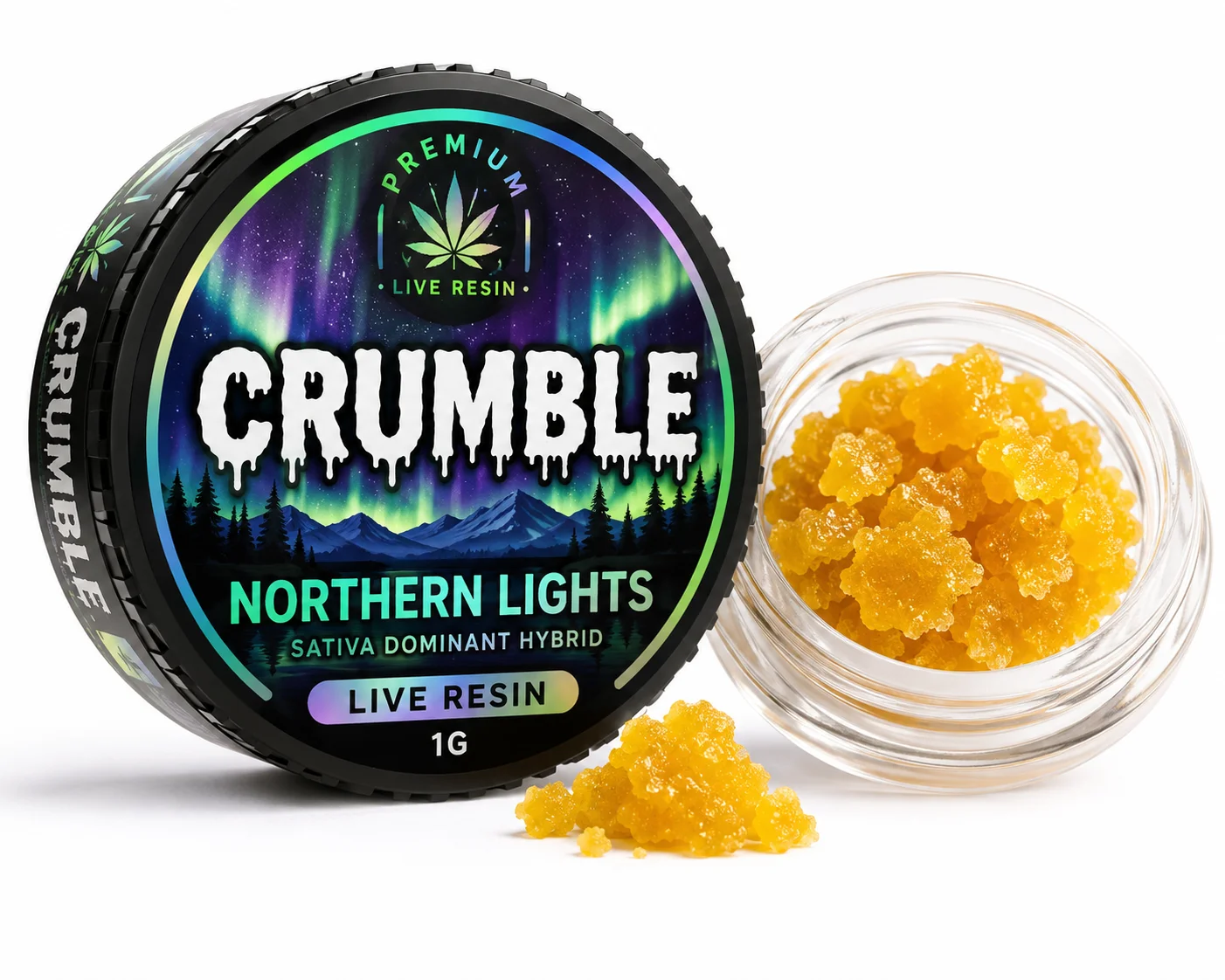
Color should be a consistent golden amber, not just bright on top with a duller interior. Texture should be crumble, meaning it breaks apart with light pressure instead of sticking to your fingers or your tool. Moisture level matters here too, good crumble is dry enough to handle cleanly but not so dry it turns to dust the second you touch it.
A few visual quality indicators worth checking: even coloring throughout the jar, no visible wet spots or pooling oil, and a texture that holds together in small pieces rather than collapsing into powder. If a jar looks patchy in color or has a slick, wet sheen on top, that can be a sign of an uneven purge.
Lighting can also throw off how a jar looks in photos, so it helps to judge appearance in person or under neutral lighting if you can. A properly purged batch should look roughly the same color whether you’re looking at it under warm indoor light or daylight, a jar that looks dramatically different depending on lighting is sometimes a sign of inconsistent curing or an older batch that’s started to darken with age.
What Makes Northern Lights Special?
Northern Lights is one of the most famous strains in cannabis history, and its origin story is part legend, part documented history. The most commonly told version says the first Northern Lights plants were grown in the late 1970s on an island near Seattle, Washington, by an anonymous breeder known only as “The Indian.” That grower is said to have raised a set of plants numbered Northern Lights #1 through #11, all built from Afghani landrace genetics, with phenotypes #1 and #5 standing out for their resin production and yield.
From there, the story goes that Dutch breeder Nevil Schoenmakers came across the strain during a trip to the US sometime in the late 1970s or early 1980s, brought clones back to the Netherlands, and released Northern Lights commercially through his seed bank around 1985. Some versions were bred as close to pure Afghani as possible, while others were crossed with Thai sativa genetics to add complexity. None of this is documented with lab paperwork, a lot of old-school strain history like this is closer to folklore passed down through the cannabis community than anything you could verify with a genetic test. But the broad strokes, Afghani landrace roots, a mysterious original breeder, and a jump to the Netherlands in the 1980s, show up consistently enough across different sources that it’s become the accepted version of events. Whatever the exact details, that story is part of what makes Northern Lights feel different from a strain with a clean, corporate origin.
What’s easier to confirm is Northern Lights’ impact. It’s widely described as a near-pure indica, often cited around 90 to 95 percent indica depending on the phenotype, and it’s known for dense, resin-heavy buds and a fast flowering time that made it popular with growers from the start. Its genetics have gone on to shape a long list of other well-known strains and hybrids, including Super Silver Haze and Shiva Skunk, and newer crosses built on backcrossed Northern Lights lines continue to show up in dispensaries under names like Northern Lemons and Northern Mints.
The numbered phenotype system is worth understanding too, since it explains a lot of the confusion people run into with this strain. “The Indian” reportedly grew out eleven separate plants, numbered Northern Lights #1 through #11, each one a slightly different expression of the same Afghani genetic base. Growers and breeders who worked with the strain afterward gravitated toward specific numbered cuts they liked best, most famously #1 and #5, and those became the foundation for most of what’s sold as “Northern Lights” today. That’s part of why you’ll sometimes see products labeled Northern Lights #5 specifically, it’s referencing one particular phenotype out of the original eleven rather than a separate strain entirely.
Over its history, Northern Lights has also picked up a fair number of awards and industry recognition at cannabis competitions, which is part of what’s kept it in steady circulation for decades instead of fading out like a lot of strains from the same era. That kind of staying power is rare in an industry where new strain names show up constantly and most of them disappear within a few years.
Extract makers keep coming back to Northern Lights for a simple reason: its terpene profile is distinct, consistent enough to be recognizable, and it represents a piece of cannabis history that a lot of newer strains simply don’t carry. Pressing it into a fresh frozen live resin is a way of tasting that decades-old genetic lineage directly, without the flavor loss that comes from a long dry and cure.
🧬 What Happened After Northern Lights Hit the Market
Once Northern Lights was available commercially through Nevil Schoenmakers’ seed bank in the mid-1980s, breeders wasted no time putting it to work. Its resin production and fast flowering made it a favorite base for new crosses, and its indica-heavy structure made it a useful counterweight to sativa-dominant genetics in hybrid breeding. Super Silver Haze, one of the most awarded strains in cannabis history, traces part of its lineage back to Northern Lights genetics crossed with haze varieties. Shiva Skunk pairs it with Skunk #1 for a different kind of hybrid vigor.
More recently, breeders have gone back to the original Northern Lights lines and backcrossed them to stabilize and refine specific traits, resin production, potency, and terpene expression among them. That’s where names like Northern Lights #5 backcrosses come from, along with newer market crosses like Northern Lemons and Northern Mints that pair the classic Northern Lights base with brighter, more modern flavor profiles. It’s a strain that’s been reworked and refined for decades without ever really disappearing from the conversation.
⚙️ Hydrocarbon Extraction, Explained in Plain Terms
Hydrocarbon extraction sounds technical, but the concept is simple. A solvent, usually butane or propane, runs through the frozen plant material inside a sealed, closed-loop system. That solvent is good at pulling resin off the plant without dragging along much of the plant fiber and chlorophyll that would make the final product taste harsh or grassy. Once the resin and solvent separate from the spent plant material, the mixture moves into a purge stage.
Purging uses heat and vacuum pressure together to pull the solvent back out, leaving the resin behind. This step is critical, since leftover solvent isn’t something you want in a product meant for inhalation. That’s exactly why residual solvent testing is a standard part of quality control for anything extracted this way, which we get into more in the quality standards section further down this page. A properly purged batch should test at safe, verified levels before it’s cleared for sale.
🫙 What’s Actually in the Jar
There’s not much of an ingredient list here, and that’s the point. A properly made live resin is just cannabis, extracted and purged, nothing else added. No flavoring, no cutting agents, no fillers. What you’re paying for is Northern Lights’ own terpene and cannabinoid content, concentrated into a small jar. Since there’s nothing else in the mix to fall back on, quality depends almost entirely on how well the extraction and purge were handled, a rushed purge or low-quality starting material will show up directly in the final flavor.
The Terpenes Behind Northern Lights
General terpene tendencies associated with Northern Lights as a strain category, not a lab-verified breakdown of this specific batch.
🌿 Myrcene
Usually the most dominant terpene in Northern Lights. It brings the deep, musky, earthy base note the strain is best known for, and it’s commonly associated with a heavier, more relaxed body feel.
🌶️ Caryophyllene
Adds a peppery, spicy warmth that shows up most on the exhale. It’s the same terpene found in black pepper and cloves, and it’s what gives Northern Lights some of its complexity instead of being a one-note earthy smell.
🌲 Pinene
Brings the sharp, forest-like pine note that cuts through the heavier earthy and spicy tones. Northern Lights tends to express more of the alpha-pinene form, which smells closest to a pine forest after rain.
🍋 Limonene (Variable)
Not every Northern Lights batch shows a strong limonene presence, but when it’s there, it adds a light citrus lift that keeps the profile from tipping too far into flat earthiness.
Northern Lights, Northern Lights #5, and the Newer Crosses
Because Northern Lights has been around since the late 1970s and gets referenced in so many other strain names, it’s easy to mix up what’s actually the original cultivar and what’s a newer cross built from it. Plain “Northern Lights” generally refers to the classic, near-pure indica line, whichever numbered phenotype a specific breeder or producer is working from. “Northern Lights #5” specifically points to one particular phenotype out of the original eleven, widely considered one of the strongest and most resin-heavy of the bunch.
Newer names like Northern Lemons, Northern Mints, and Northern Runtz are hybrids that use Northern Lights genetics as one parent, crossed with something else to add a different flavor lean, usually something brighter or sweeter. They’re related to this product’s flavor profile, but they’re not the same thing as straight Northern Lights, and you shouldn’t expect them to taste identical. If you’re specifically after that classic earthy, piney profile, look for products labeled plain Northern Lights or Northern Lights #5, not one of the newer crosses.
Why Northern Lights Hasn’t Faded Out
Cannabis strain trends move fast. Most names that were popular ten years ago barely show up on shelves today, replaced by newer crosses chasing whatever flavor category is trending that season. Northern Lights is one of the rare exceptions. Nearly fifty years after its origin story on that island near Seattle, it’s still grown, still extracted, and still specifically requested by people who know what they’re looking for.
Part of that staying power comes from genetics, its indica-dominant structure and resin production made it a reliable parent strain for decades of breeding projects, which kept it circulating even as its own name occasionally took a back seat to whatever hybrid it helped create. Part of it comes from flavor, earthy and piney profiles don’t go out of style the way trendier dessert or candy flavors sometimes do. And part of it is just reputation, a strain that’s been consistently good for this long earns a kind of trust that newer, less-tested genetics haven’t had the time to build yet.
From Fresh Harvest to Finished Crumble
Fresh Harvest
Northern Lights plants are cut at peak ripeness, same as they would be for flower headed to market.
Flash Freezing
Instead of hanging to dry, the fresh plant goes straight into a freezer, often within hours of being cut.
Extraction
The frozen material runs through a closed-loop hydrocarbon system, which pulls the resin out under controlled temperature and pressure.
Purification
A vacuum oven removes the leftover solvent using heat and low pressure, leaving the finished concentrate behind.
Terpene Preservation
Lower processing temperatures throughout extraction and purging help hold onto more of the earthy, piney terpene profile Northern Lights is known for.
Quality Testing
The finished batch goes through lab testing for potency, residual solvents, and contaminants before it’s cleared for sale.
Packaging
Once approved, the crumble is packaged in an airtight, non-stick container sized to help preserve freshness until it reaches you.
Why This Step Changes Everything
Terpenes start breaking down the moment a plant is cut. A normal dry and cure takes days to weeks, and a lot of the strain’s original aroma fades during that window. Freezing the plant within hours of harvest basically stops that clock, which is why fresh frozen live resin tends to preserve more aroma, protect more of the fragile terpene content, and hold onto a flavor that’s closer to what the living plant actually smelled like.
That matters even more for a strain like Northern Lights, where the earthy, piney character is exactly what people are buying it for. Freshness also plays into consistency. Because the plant’s profile gets locked in early, rather than shaped by however much survived a long cure, batches tend to taste more like Northern Lights is supposed to taste, instead of a flattened, generic version of it.
It’s worth pointing out that fresh frozen extraction doesn’t automatically mean stronger in terms of potency, that’s a separate spec tied to cannabinoid content, not terpene preservation. What fresh frozen extraction reliably delivers is accuracy, a truer representation of what the strain actually smells and tastes like, rather than a bigger effect. If potency is your main concern, check the label or COA specifically for that, don’t assume it based on the live resin label alone.
What “Small Batch” Actually Buys You
Small batch production sounds like a marketing phrase, but it has a real, practical effect on quality. Running smaller amounts of material through extraction and purging at once gives producers tighter control over temperature and timing at every step. That precision is a lot harder to maintain at large industrial scale, where consistency across a huge volume of material tends to matter more than fine-tuning any individual run.
For a strain like Northern Lights, where the appeal comes down to a specific, recognizable terpene profile, that level of control is what separates a batch that actually tastes like Northern Lights from one that tastes like a generic earthy concentrate. Small batch production usually means fewer jars per run, which is part of why batch-to-batch variation, covered earlier on this page, is something to expect rather than something gone wrong.
There’s a tradeoff worth naming honestly: small batch production is slower and generally more expensive per unit than large-scale processing. That cost tends to show up in the price. Whether that tradeoff is worth it comes down to how much the flavor accuracy actually matters to you. For a lot of Northern Lights fans specifically, people who’ve been chasing that classic earthy, piney profile for years, it usually is.
What a Dab Actually Feels Like, Start to Finish
Fresh Pine
The first thing you notice is a sharp, clean pine note, almost like walking into a forest right after rain.
Earthy Herbs
That pine settles into a deeper, muskier earthiness, with a green, herbal quality underneath it.
Soft Spice
A light peppery warmth shows up on the exhale, courtesy of caryophyllene, rounding out the heavier earthy tones.
Clean Woodland Notes
What’s left behind is a lasting woodsy, herbal scent that sticks around well after the hit is done.
Where Crumble Fits Among Live Resin Textures
Dry, flaky, breaks apart easily. This product’s texture.
Soft and opaque, whipped to a smooth, spreadable consistency.
Similar to budder, whipped while it still holds more moisture, staying cake-like.
Grainy and wet, sitting between sauce and badder in consistency.
Liquid terpene layer over separated cannabinoid crystals, sticky and hard to handle.
Pure THCA crystals, usually paired with a terpene sauce for flavor.
Crumble sits on the drier end of the spectrum, which trades a little bit of peak-freshness punch for much easier handling and storage. That tradeoff tends to suit an earthy, pine-forward strain like Northern Lights well, since the flavor doesn’t rely on bright, delicate top notes the way a citrus-forward strain might.
How to Store Northern Lights Live Resin
| Do | Avoid |
|---|---|
| Store cool, ideally in a fridge for long-term storage | Heat, including warm cars or sunny windowsills |
| Use an airtight glass container | Direct sunlight and UV exposure |
| Keep it stored upright | Excess moisture or humid storage spots |
| Let it warm to room temp before handling | Repeated warming and cooling cycles |
Crumble Live Resin Northern Lights Specs
Batch-specific numbers that we can’t verify are marked as not officially disclosed instead of estimated.
Northern Lights vs. Other Crumble Live Resin Flavors
If earthy and piney isn’t quite what you’re after, here’s how it stacks up against a few other flavors in the lineup.
| Flavor | Primary Notes | Best For |
|---|---|---|
| Northern Lights | Earthy, pine, herbal, mild spice | Classic, old-school indica flavor fans |
| Candy Gas | Sweet, gassy, dessert-leaning | Fans of sweeter, fuel-forward hybrids |
| Sour Diesel | Sharp citrus, sour, fuel | Sativa-leaning, energetic flavor seekers |
| Rainbow Belts | Fruity, candy-like, tropical | Dessert and fruit strain fans |
If you’re torn between two of these, think about what you actually reach for in flower first. People who gravitate toward earthy, piney indica flower tend to enjoy Northern Lights live resin the most, while people who already prefer sweeter or citrus-forward strains might get more out of Candy Gas or Sour Diesel instead.
How to Actually Dab Crumble Live Resin
Go low and slow
Low-temperature dabs protect the terpenes behind Northern Lights’ earthy, piney flavor. High heat burns off a lot of that complexity and leaves mostly just a burnt, flat taste.
Use a clean banger
Leftover reclaim from a different strain will muddy the earthy, herbal profile this concentrate is known for. A quick wipe or swap keeps the flavor clean.
Portion it out ahead of time
Crumble breaks apart easily, which makes it simple to measure out a small dab before you start instead of guessing mid-session.
Let your rig cool slightly between hits
A banger still too hot from the last dab will torch the terpenes on contact. A few extra seconds between hits protects the flavor.
Start small if you’re less experienced
Concentrates are more potent than flower by volume. A small dab goes a long way, especially with an indica-leaning strain known for heavier effects.
Given its reputation as a heavier, more relaxing indica, a lot of people save this one for evenings or downtime rather than the middle of a busy day. That’s a personal preference thing, not a rule, but it’s worth keeping in mind if you’re planning around it.
Mistakes People Make Buying Live Resin
Check the Label
Not every product labeled live resin was actually made from fresh frozen material. Confirm fresh frozen extraction specifically before assuming.
Ask for Lab Results
A good-looking label doesn’t confirm potency, purity, or residual solvent levels. Always request the current certificate of analysis.
Watch Heat and Humidity
A warm car or sunny windowsill degrades flavor fast, and repeated fridge-to-counter swings stress the terpenes over time.
Keep It Low
Torching a banger until it glows burns off the flavor you paid for. If it tastes harsh and flat, the temperature is probably too high.
What to Expect From Batch to Batch
Small batch live resin isn’t going to taste perfectly identical every single time. Northern Lights pulled from one harvest can smell and taste slightly different than the next batch, depending on growing conditions, harvest timing, and how the plant was handled between cutting and freezing. That’s normal when you’re working with a living plant instead of a standardized formula.
This is different from distillate, which is often blended specifically to taste the same every time. Live resin trades that uniformity for a more accurate snapshot of each individual harvest. Most of the time the differences are subtle, maybe a bit more pine in one batch, a bit more earth in another, but it helps to know that going in so two jars of the “same” strain aren’t expected to taste 100 percent identical.
If consistency matters more to you than tasting each individual harvest’s character, it’s worth checking the batch or extraction date on the label and sticking with a single restock when you find one you like, rather than assuming every future jar will match it exactly.
What People Generally Report
Everyone’s experience with cannabis is different, and that depends on more than just the strain, tolerance, dose, consumption method, and individual body chemistry all play a role. So we won’t tell you exactly how this will make you feel. What we can say is that Northern Lights has a long-standing reputation as a heavier, body-focused indica, often described anecdotally as deeply relaxing with a calming, sedative quality, especially useful later in the day. That’s based on general strain reputation built up over decades, not anything specific to this exact batch. Take that reputation as a general reference point, not a promise.
If you’re new to concentrates or trying this strain for the first time, start with a small amount and give it time before deciding whether to take more. This isn’t medical advice and it isn’t a guarantee of any particular effect, it’s just background based on how this strain has typically been described within the cannabis community.
Where This Product Can Legally Be Sold
Cannabis concentrates can only be sold and shipped where local law allows it, and that varies significantly by state and country. Before ordering, confirm that shipping to your specific location is actually legal, a website being reachable from your area doesn’t mean the product can legally ship there.
Licensed retailers typically verify age at checkout and again at delivery, and packaging is usually discreet and tamper-evident. If a seller skips age verification or seems vague about licensing, treat that as a red flag regardless of how good the product looks in photos. A legitimate retailer should also list a business address or license number somewhere on their site without you having to dig for it.
None of this should feel complicated. A retailer that’s confident in what they’re selling will hand over licensing details and a current COA without making it difficult, and they’ll have a clear return policy in case something arrives damaged. If any of that feels like pulling teeth, look elsewhere before you check out.
Crumble Live Resin Northern Lights: FAQs
1. What makes Crumble Live Resin Northern Lights different from cured resin?
Cured resin comes from flower that was dried and cured first, which loses some terpenes along the way. This live resin starts from Northern Lights plants frozen right after harvest, which keeps more of the plant’s original earthy, piney aroma intact.
2. Why is Northern Lights known for its earthy flavor?
It’s built around a terpene profile that usually leans heavily on myrcene, giving it that deep, musky, earthy base, rounded out by pinene’s pine note and caryophyllene’s peppery spice.
3. How does fresh frozen extraction preserve terpenes?
Freezing the plant within hours of harvest skips the drying and curing process, which is normally when a lot of terpenes break down or evaporate. That preserves more of the plant’s original terpene content.
4. What texture should premium crumble live resin have?
It should break apart easily with light pressure, look dry but not powdery or dusty, and hold a consistent golden color from top to bottom.
5. How should crumble live resin be stored?
Keep it in an airtight glass container, somewhere cool and dark, away from sunlight and repeated temperature swings. A fridge or freezer works well for longer-term storage.
6. Why do terpene levels matter?
Terpenes are what drive flavor and aroma, and they’re a big part of what makes one strain smell and taste noticeably different from another, even at similar potency levels.
7. What gives Northern Lights its pine aroma?
Pinene is the terpene mainly responsible for that sharp, forest-like pine smell, and Northern Lights tends to express it alongside myrcene’s earthiness and caryophyllene’s spice.
8. How can I identify premium-quality live resin?
Look for a strong aroma the moment the jar opens, a consistent color and texture throughout the batch, and ask for a current certificate of analysis covering potency, residual solvents, and contaminant testing.
9. Is Northern Lights the same as Northern Lights #5?
Not exactly. Northern Lights #5 refers to one specific phenotype out of the original numbered plants, widely considered one of the strongest cuts. Plain Northern Lights can refer to any phenotype from that same original line.
10. Why does batch color or flavor sometimes vary slightly?
Live resin is a small batch product made from individual harvests, so subtle differences in growing conditions, harvest timing, and curing can shift flavor and color slightly from one restock to the next. That’s normal and expected.
What Should Actually Be Tested
Quality in this category isn’t just about how a jar looks in a product photo, though appearance matters too. It comes down to what happens before the product is ever listed for sale, how the plant was frozen and handled, how carefully extraction was run, and whether the purge actually cleared the solvent to a safe, tested level. A jar can look flawless and still fall short if that testing step got rushed or skipped entirely.
Quality for a product like this comes down to a short list of real checks, not marketing language. Cannabinoid profile testing confirms actual THC and cannabinoid content instead of a guess printed on packaging. Residual solvent testing matters specifically because this is a hydrocarbon-extracted product, it confirms the purge step actually removed the solvent down to a safe, tested level. Microbial screening checks for mold and bacteria, heavy metals testing checks for contaminants like lead and cadmium, and pesticide screening confirms the plant was grown within legal limits.
We’d rather point you toward asking for a current COA than print numbers we can’t verify for this exact batch. Potency, terpene percentage, and specific lab results are marked not officially disclosed throughout this page for that reason. A retailer confident in their product should hand over a COA without hassle.
🔬 What Each Test Actually Checks For
Cannabinoid profile testing measures actual THC, CBD, and related cannabinoid content, which should come from a lab, not an estimate on the packaging.
Residual solvent testing applies specifically to hydrocarbon-extracted products like this one. It confirms the butane or propane used during extraction was purged out to a level considered safe for inhalation.
Microbial screening checks for mold, yeast, and bacteria, which can develop if plant material isn’t handled or stored correctly before extraction.
Heavy metals testing checks for contaminants like lead, arsenic, cadmium, and mercury, which can occasionally show up through soil, water, or improperly maintained extraction equipment.
Pesticide screening confirms the plant was grown within legal pesticide limits. Regulations differ by state, but a clean pesticide panel is a basic expectation for any legally sold cannabis product.
Together, these five categories cover what a COA should confirm before a product reaches a shelf. If a listing can’t produce a current one covering these areas, that’s a real gap worth asking about, not a minor detail to overlook.
The Short Version, If You Skipped Ahead
Fresh frozen Northern Lights, extracted with hydrocarbon extraction and purged into a golden crumble. Earthy, pine, and herbal flavor with mild sweetness and a peppery finish. No cutting agents, no added flavoring.
Ask for the current COA covering potency and residual solvent. Confirm the retailer is licensed to ship to your state. Store it in glass, cool and dark. Start small if you’re new to concentrates or this strain.
Should You Buy Crumble Live Resin Northern Lights?
If you want a concentrate that tastes like classic, old-school cannabis instead of something sweet or fruity, this is built for that. Northern Lights leans on decades of history and a genuinely distinct terpene profile, earthy, piney, and herbal, that fresh frozen extraction helps carry straight into the jar. It’s not going to be for someone chasing bright citrus or candy flavors, but if you want the flavor that shaped an entire generation of indica-leaning hybrids, this is a straightforward, honestly labeled way to try it.
Before you buy, check the current COA, confirm the retailer is licensed where you live, and plan to store it properly once it arrives. Do that, and you’re not just picking up a jar of concentrate, you’re tasting a piece of cannabis history that’s been shaping strains for close to fifty years.
And if Northern Lights ends up being too heavy or too earthy for your taste, that’s useful information too. This page laid out the flavor, the aroma, and the effects reputation as plainly as we could specifically so you could make that call before buying, not after opening the jar.


Reviews
There are no reviews yet.